Bystander effect · Confidence · CPR
Why people freeze in emergencies — and how confidence changes everything
2 July 2026 · 6 min read
Most people who witness a medical emergency don't step in. It isn't cowardice — it's predictable psychology. Here's what stops bystanders, and why confidence is the skill we teach hardest.
Ask any paramedic in Barbados and they'll tell you the same thing: they arrive at scenes where a dozen people are standing around a collapsed casualty and no one has done anything. Not one chest compression. Not one call for the AED that's mounted 20 metres away. This isn't a Barbados problem — it's a human problem, and it's the reason our courses spend as much time on the psychology of acting as they do on technique.
The five reasons bystanders don't help
1. Fear of doing it wrong
By far the biggest one. People are terrified of "making it worse" — cracking a rib, doing CPR on someone who is only fainted, hurting a child. The truth: a casualty in cardiac arrest is clinically dead. You cannot make dead worse. Broken ribs heal. Brain death from four minutes of no oxygen does not.
2. Fear of legal consequences
Covered in detail in our Good Samaritan post — but in short, in Barbados a good-faith rescuer acting within their training has no realistic legal exposure. The fear is much bigger than the reality. We're also the first aid school leading the national push for a written Good Samaritan Act so this fear disappears entirely — sign the petition.
3. The bystander effect
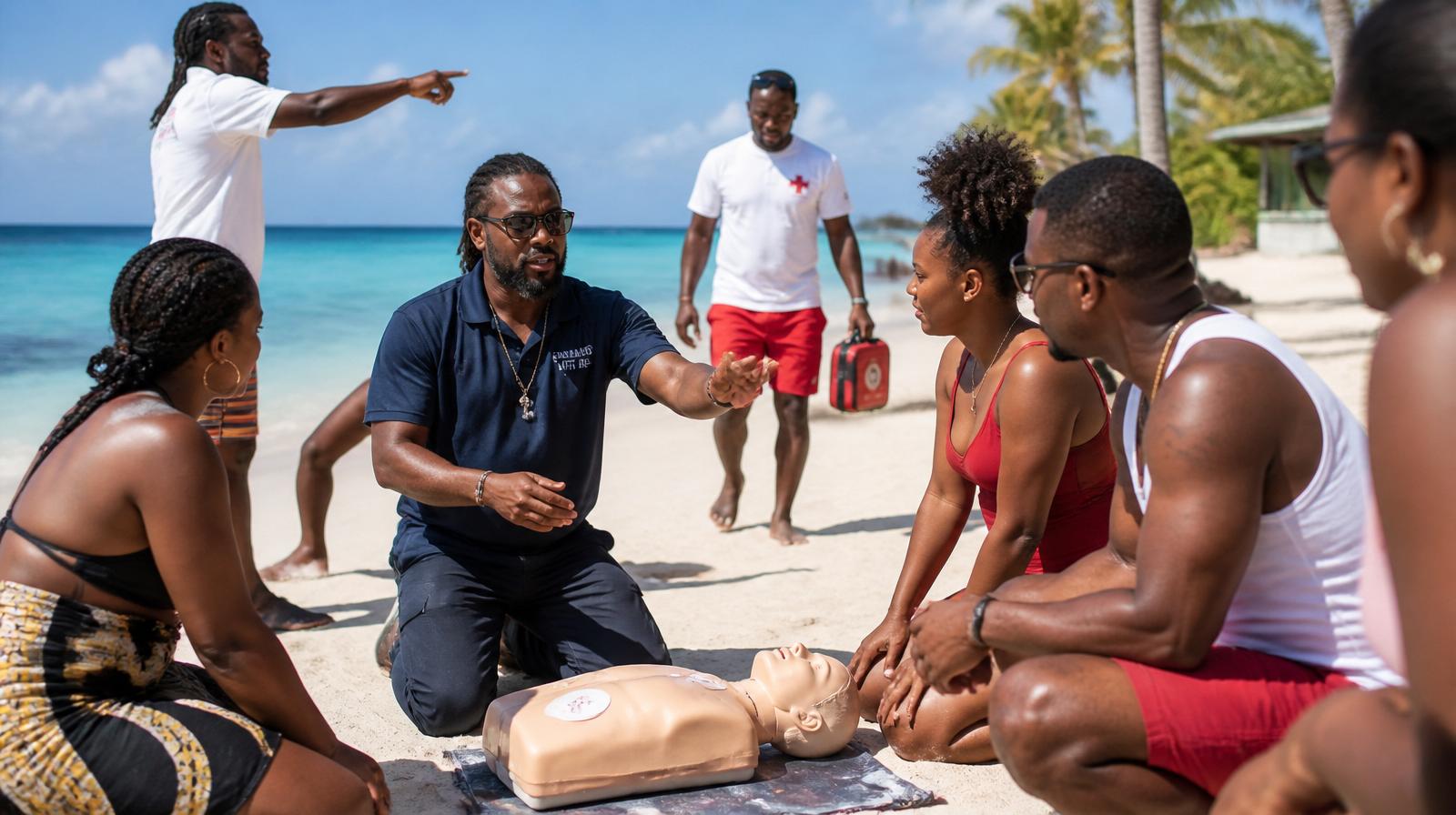
Documented since the 1960s: the more people watching, the less likely any one of them acts. Responsibility diffuses. Everyone assumes someone else — someone more qualified, someone closer, someone bolder — will step forward. If you are ever the casualty, and there is a crowd, this is the single force working against your survival. The fix is trained rescuers who know to point at a specific person and give them a specific job: "You in the blue shirt — call 511 now. You in the yellow — get the AED from reception."
4. Disgust and fear of contact
Vomit, blood, unfamiliar bodies, mouth-to-mouth on a stranger. This is real and it's rarely talked about honestly. Modern CPR teaching accepts it: hands-only CPR is now the recommended standard for untrained bystanders, and pocket masks solve the rescue-breathing hesitation for trained ones. We supply and teach with both.
5. Freeze response
Under acute stress, the human brain shortcuts to fight, flight, or freeze. Freeze is the most common response in people with no training, because their brain has no rehearsed pattern to fall back on. Training is what gives the brain that pattern. When you've physically knelt down, put your hands on a manikin, and compressed to the beat of "Stayin' Alive" thirty times, your body knows what to do before your fear catches up.
Why confidence is the skill we teach hardest
Every accredited course in the world teaches the same compression rate, the same AED sequence, the same recovery position. What separates a course that works in a real emergency from one that just issues a certificate is whether the student leaves the room genuinely believing they can do it.
That's the piece we obsess over:
- Realistic scenarios, not slideshows. Wet manikins, sandy floors, loud rooms, distraction. If your first realistic scenario is the real one, you'll freeze.
- Small groups. Everyone gets hands on the manikin repeatedly, not once at the end.
- The "point and delegate" drill. We practise it out loud until it feels natural, because in a real crowd it is the difference between chaos and a working rescue.
- Permission to be imperfect. Students leave knowing that imperfect CPR is infinitely better than no CPR. Perfectionism is a killer.
The measure of a good first aid course
A month after the course, could you walk into a real emergency and act? That's the only question that matters. If the answer is no, the course failed regardless of what the certificate says. That's why the feedback we care about isn't "great course" — it's the messages we get from past students who used what they learned. We've had plenty. That's why we teach the way we do.
If you or your team want training that produces people who act, not just people who hold certificates, that's what we do. Book a course or arrange training for your team.